
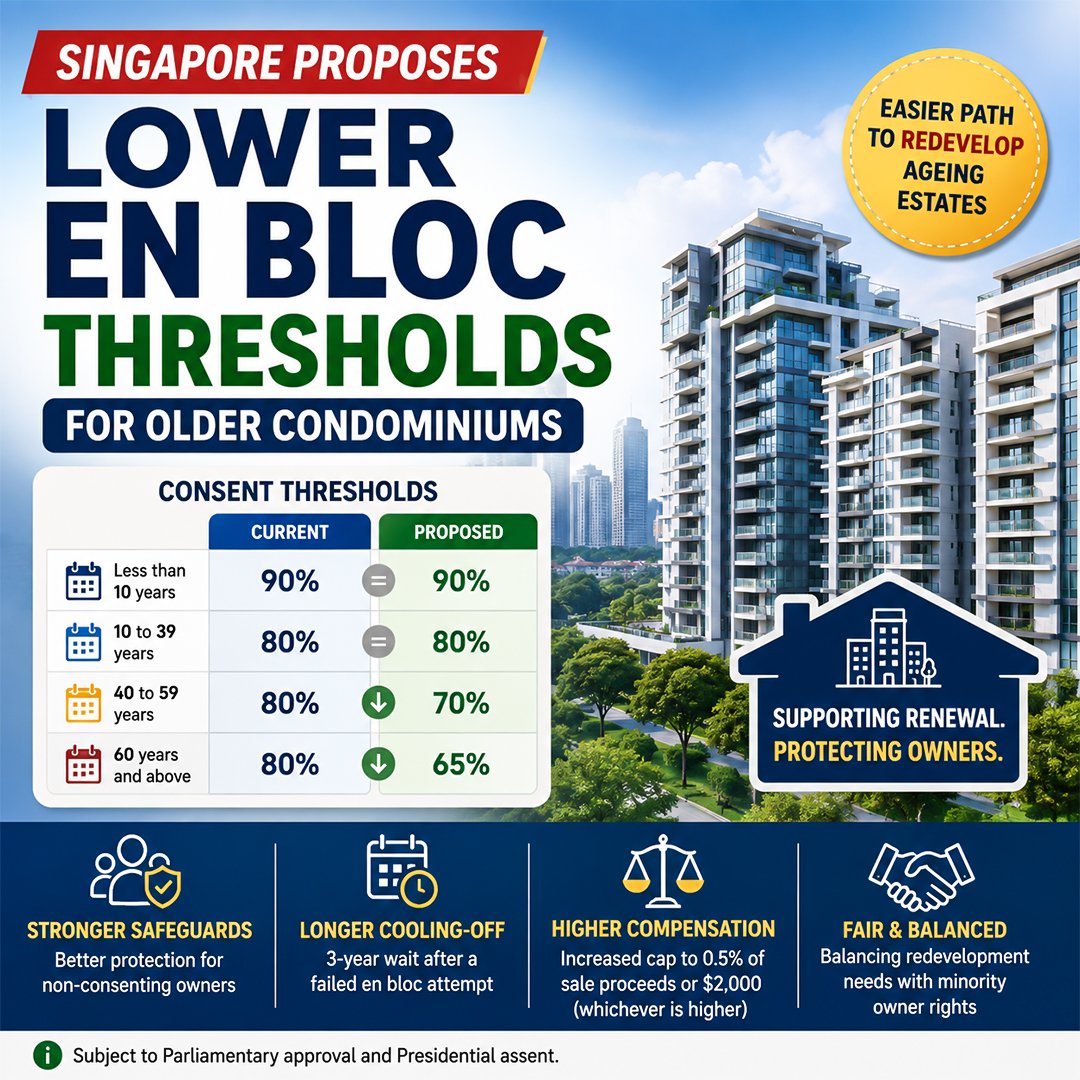
New En Bloc Rules Proposed for Older Singapore Condos
Proposed legislation could make collective sales easier for ageing condominiums while introducing stronger protections for homeowners who choose not to sell.
Older Condominiums in Singapore Could Soon Find It Easier to Go En Bloc
Thousands of homeowners living in older private condominiums across Singapore could soon see new opportunities for redevelopment under proposed changes to the country’s collective sale laws.
The Ministry of Law has introduced amendments that would lower the owner consent thresholds required for older developments to proceed with an en bloc sale.
While the proposal is intended to support the renewal of ageing residential estates, it also introduces stronger safeguards to protect homeowners who prefer not to participate in a collective sale.
If approved by Parliament, the new rules could reshape Singapore’s collective sale landscape by making redevelopment more achievable for ageing condominiums that have struggled to meet the current approval requirements.
📋 At a Glance
🟢 Who is affected?
Owners of private residential developments aged 40 years and above.
🏢 What’s changing?
The required owner consent for older en bloc sales could be reduced from 80% to 70% for developments aged 40 to 59 years, and to 65% for developments aged 60 years and above.
🛡️ What protections are included?
The Bill introduces stronger safeguards for non consenting owners, including stricter requirements for starting collective sale exercises and enhanced protections during the process.
⚖️ What happens next?
The proposed legislation will be debated in Parliament before a vote. If passed, the amendments will come into effect on a later date announced by the Government.
Why is Singapore Changing the En Bloc Rules?
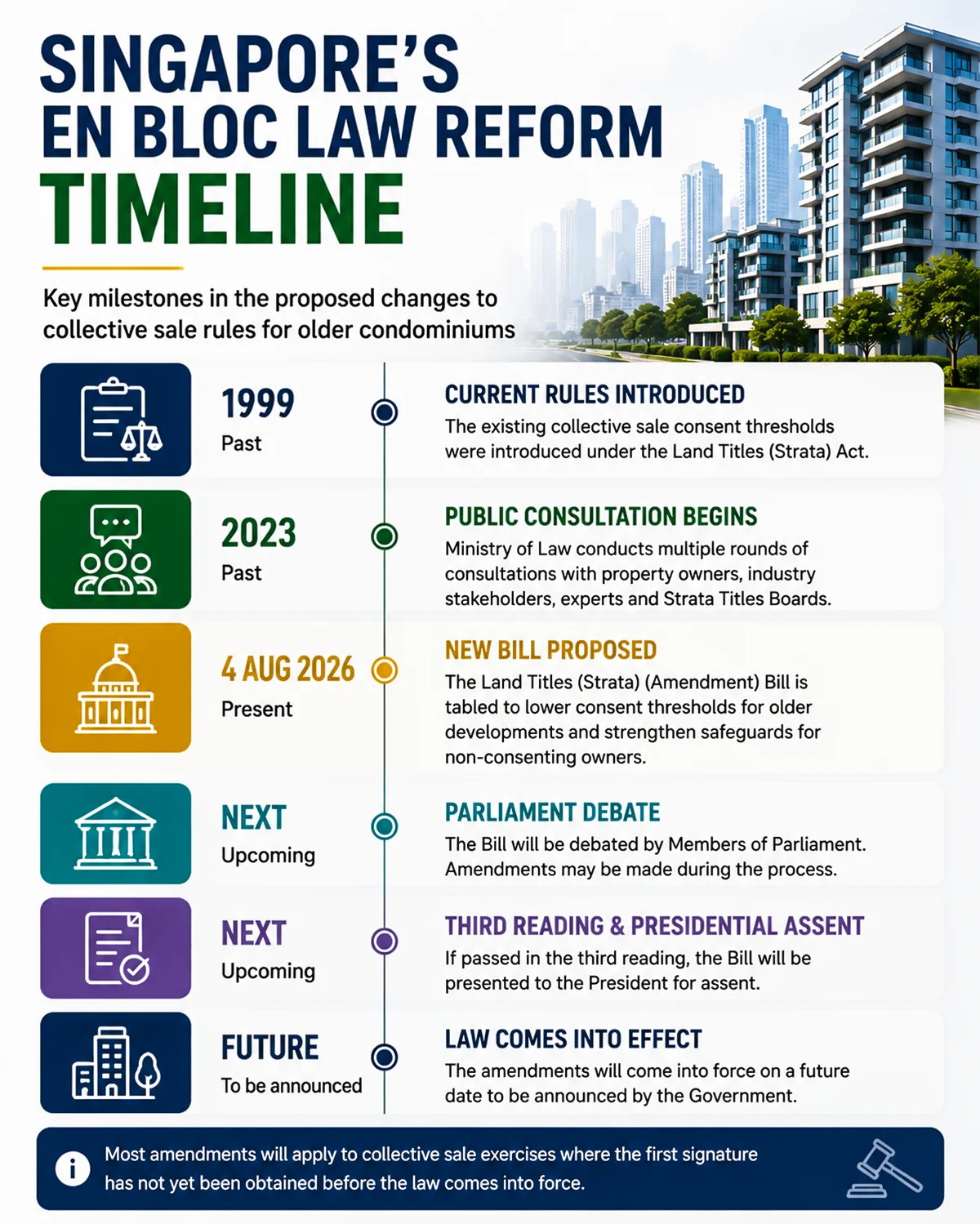
Singapore’s existing collective sale consent thresholds have remained largely unchanged since they were introduced in 1999.
Over the years, many private residential developments have become significantly older. As buildings age, owners often face increasing maintenance costs, major repair works, and upgrading projects that require substantial financial investment.
Rather than continuing to spend heavily on ageing buildings, some owners may prefer redevelopment through an en bloc sale.
According to the Ministry of Law, lowering the consent threshold provides a more practical option where there is already broad support among residents.
The proposal also follows extensive public consultations involving property owners, lawyers, developers, academics, consultants, industry associations, and representatives from the Strata Titles Boards.
What Are the Proposed New Consent Thresholds?
The biggest proposed change is a reduction in the owner approval required for older developments.
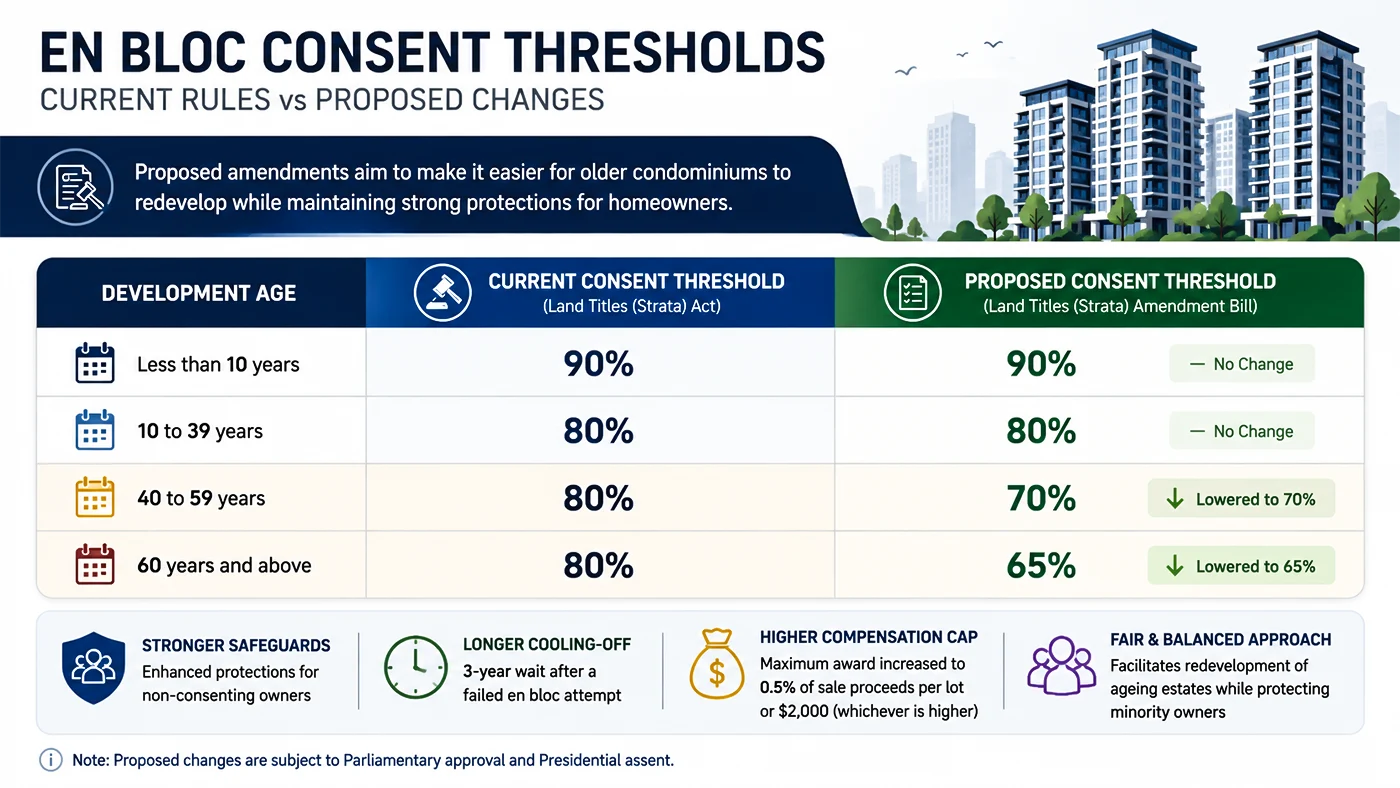
The Government has emphasised that newer developments will continue under the existing framework because they generally have longer remained lifespans and fewer maintenance concerns.
What This Could Mean for Older Condominium Owners
For residents living in ageing developments, the proposal could open new possibilities that were previously difficult to achieve.
🏢 More ageing estates may qualify for redevelopment.
💰 Owners could avoid increasingly expensive long term maintenance costs.
🏗️ Developers may have greater interest in acquiring older residential sites.
📈 Urban renewal could help modernise ageing neighbourhoods across Singapore.
Many developments built during earlier decades now require significant repairs to mechanical systems, lifts, facades, waterproofing, and common facilities. Redevelopment may become a more attractive long term solution than repeated upgrading works.
Government Data Shows Singapore’s Housing Stock is Getting Older
The Ministry of Law highlighted the growing number of ageing private residential developments.
Currently,
📊 More than 360,000 private non landed residential units are below 40 years old.
🏢 Around 20,000 private non landed residential units are already more than 40 years old.
As more developments cross the 40 year mark over the coming decades, the number of condominiums potentially affected by the proposed legislation is expected to grow.
New Rules Also Cover Certain Non-Strata Residential Developments
The proposed amendments extend beyond traditional condominiums.
Certain private residential developments that are not strata titled currently require unanimous agreement between flat owners and landowners before a collective sale can take place.
Under the proposed framework, these developments may instead proceed through a majority consent process, while retaining safeguards that protect landowners’ interests.
This could simplify redevelopment for selected developments that previously faced more complex ownership structures.
Stronger Protection for Homeowners Who Do Not Want to Sell
Although lower consent thresholds may make collective sales easier, the proposed Bill also strengthens protections for minority owners.
Higher Support Needed Before Starting an En Bloc Exercise
Before forming a Collective Sale Committee, owners will need greater initial support.
📌 Proposed requirement
35 percent of owners by either share value or number of units.
This is higher than the existing requirements and aims to ensure only developments with meaningful owner support begin the collective sale process.
Less Time to Collect Signatures
Collective Sale Committees would have only six months instead of twelve months to gather owner signatures.
The Ministry explained that this reduces prolonged pressure on homeowners who do not wish to participate.
Longer Cooling Off Period
Where an en bloc attempt fails, owners would need to wait three years before another attempt instead of the current two years.
This prevents repeated collective sale attempts where sufficient owner support does not exist.
Higher Compensation for Successful Objectors
The Bill also increases the maximum amount courts may award to successful objectors from the collective sale proceeds.
This provides additional protection for homeowners whose objections are upheld.
Will Existing En Bloc Projects Be Affected?
Not every ongoing collective sale will automatically move to the new rules.
According to the Ministry of Law,
✅ Projects that have not yet obtained the first owner signature may come under the new legislation.
✅ Projects that already secured the first signature will continue under the existing framework.
✅ Committees still collecting signatures may choose to restart under the proposed rules through a new agreement approved by owners.
How This Fits into Singapore’s Bigger Housing Strategy
The proposal follows another recent policy change aimed at supporting redevelopment.
The Government recently announced longer Additional Buyer’s Stamp Duty timelines for developers undertaking large en bloc projects.
Together, both measures suggest a broader strategy to encourage the renewal of ageing residential estates while supporting future housing supply across Singapore.
What Happens Next?
The proposed amendments will next be debated in Parliament.
If Members of Parliament approve the Bill during its third reading and it subsequently receives Presidential assent, the changes will take effect on a future date announced by the Government.