
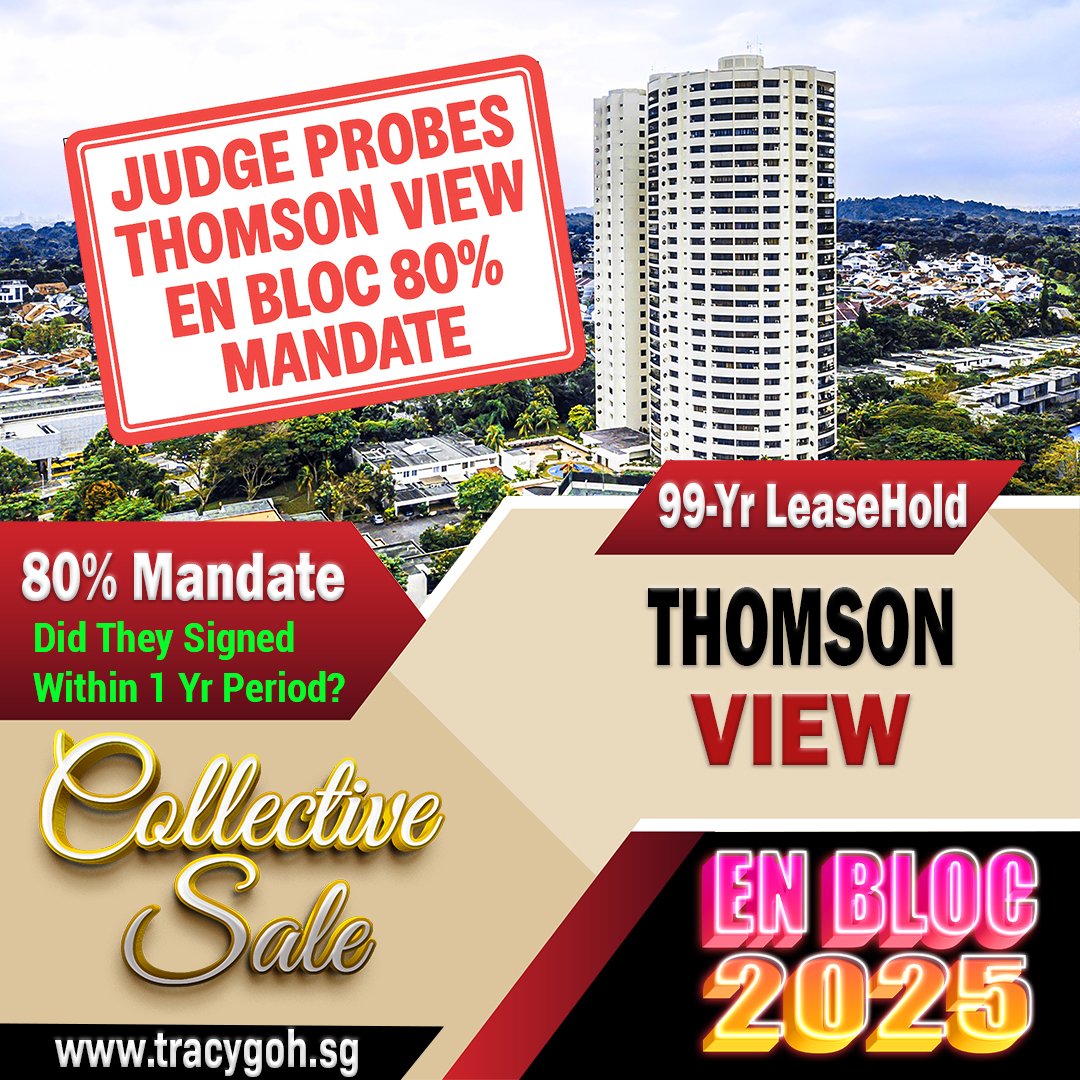
Judge Probes Thomson View En Bloc 80% Mandate
High Court Questions Timeline Compliance in Singapore’s Largest Potential Property Deal Since 2023
Singapore’s property market is holding its breath as a High Court judge raises critical questions about what could become the largest en bloc sale since 2023.
The S$810 million Thomson View Condominium deal, involving over 200 units and backed by major developers UOL, Singapore Land, and CapitaLand Development, now faces serious legal scrutiny over whether it truly secured the mandatory 80% owner consent within the required timeframe.
On May 22, 2025, Justice Audrey Lim sent shockwaves through the courtroom when she questioned whether some of the 206 crucial signatures were obtained outside the legally stipulated 12-month window.
For the more than 20 unitholders who attended the public hearing, what was supposed to be a routine court approval suddenly became a moment of uncertainty that could make or break their collective sale dreams.
The S$810 Million Deal Under the Microscope
Thomson View Condominium, nestled along Bright Hill Road, represents more than just another property transaction.
With its S$810 million price tag translating to S$1,178 per square foot per plot ratio, this five-hectare development has captured the attention of Singapore’s property sector as a potential market bellwether.
The consortium of UOL, Singapore Land, and CapitaLand Development has ambitious plans to transform the current 200 apartments, 54 townhouses, and single shop unit into a sprawling 1,240-unit project.
The deal’s journey began in February 2024 when the property was put up for tender, though it took until November for the developers to exercise their option after months of negotiations.
What makes this transaction particularly noteworthy is its potential to claim the title of Singapore’s largest en bloc sale since Chuan Park’s S$890 million deal in May 2023, signaling renewed confidence in the collective sale market.
Legal Complications Emerge in Court
The plot thickened considerably when Justice Audrey Lim identified discrepancies that could derail the entire transaction.
The judge’s concerns centered on whether the collective sale committee truly obtained the required 80% mandate within the critical 12-month period running from January 8, 2023, to January 7, 2024.
Adding to the complexity, Hui Choon Wai from law firm Wee Swee Teow, representing the collective sale committee, revealed that while 211 unitholders signed the original collective sale agreement, only 206 signed the supplementary agreement.
This five-signature difference has prompted the court to demand detailed explanations about how these two documents differ and why the discrepancy exists.
The judge has given the collective sale committee three weeks to file additional affidavits addressing these concerns, specifically requiring them to explain how many unitholders signed within the prescribed timeframe and what proportion they represent in terms of shares and plot size.
The Strategic Price Reduction That Changed Everything
Behind the legal technicalities lies a fascinating story of market adaptation. Thomson View owners originally set their sights high with a reserve price of S$918 million, but market realities forced a strategic pivot.
When the September 2024 tender closing failed to secure a buyer at the asking price, owners made the pragmatic decision to lower their expectations.
In October 2024, a supplementary agreement was signed to reduce the reserve price to S$808 million, a 12% decrease that ultimately paved the way for the developers’ S$810 million offer.
This price adjustment strategy, while successful in attracting buyers, has now become a focal point of the court’s investigation into the timing and validity of owner consent.
The move demonstrates the delicate balance between owner aspirations and market realities in Singapore’s competitive property landscape, where timing and flexibility often determine success or failure.
From Opposition to Withdrawal: The Objectors’ Journey
The path to court wasn’t smooth.
In March 2025, the collective sale faced a significant hurdle when a stop order was filed following unsuccessful mediation attempts.
A small group of owners had raised objections to the Strata Titles Board, citing concerns about financial loss and questioning whether the sale was conducted in good faith.
However, the landscape shifted dramatically when all six objectors eventually withdrew their complaints.
While the specific grounds for their initial opposition remain unclear, their withdrawal cleared what seemed to be the final obstacle to court approval.
Yet Justice Lim’s questions about timeline compliance have introduced an unexpected new challenge that could prove more significant than the original objections.
This turn of events highlights the unpredictable nature of en bloc sales, where legal technicalities can sometimes pose greater threats than owner opposition.
Understanding Singapore’s En Bloc Legal Framework
The 80% consent requirement isn’t just a formality—it’s a cornerstone of Singapore’s en bloc sale legislation designed to protect minority owners while enabling collective sales.
The law requires that at least 80% of owners, representing 80% of the share value and strata area, must agree to the sale within a specific 12-month window.
This timeframe creates significant pressure on collective sale committees to secure signatures efficiently while ensuring all documentation is properly executed.
The distinction between the main collective sale agreement and supplementary agreements has now emerged as a critical compliance issue that could affect future en bloc sales across Singapore.
The current case underscores the importance of meticulous documentation and timeline management in collective sales, where even minor procedural errors can jeopardize multi-million-dollar transactions.
Market Impact and Industry Implications
Thomson View’s legal challenges are being closely watched by property developers, owners considering collective sales, and legal professionals across Singapore.
The case could establish important precedents about documentation requirements and timeline compliance that will influence future en bloc sales.
For the broader market, the outcome will signal whether Singapore’s en bloc sale framework provides sufficient certainty for major property investments.
Developers like UOL, Singapore Land, and CapitaLand Development have remained notably silent about the proceedings, likely waiting to see how the legal questions are resolved before making any public statements.
The case also highlights the evolving dynamics of Singapore’s property market, where collective sales remain an important mechanism for urban renewal but must navigate increasingly complex legal requirements.
What’s Next for Thomson View Owners
The immediate focus shifts to the collective sale committee’s response to Justice Lim’s concerns.
With three weeks to file the required affidavits, they must provide clear evidence that the 80% threshold was met within the legal timeframe and explain the discrepancies between the main and supplementary agreements.
The next court hearing is scheduled for July 1, 2025, where Justice Lim will review the additional documentation and determine whether to approve the sale or require further clarification.
For the unitholders who attended the May 22 hearing, many visibly shaken by the unexpected turn of events, the wait continues.
Should the court find that proper procedures weren’t followed, the collective sale committee may need to restart portions of the consent process, potentially delaying or even derailing the S$810 million transaction.
A Precedent-Setting Moment for Singapore Property
The Thomson View case represents more than just one condominium’s collective sale journey—it’s a test of Singapore’s en bloc sale framework’s robustness and clarity.
As the largest potential en bloc deal since 2023, its outcome will be closely scrutinized by industry stakeholders seeking guidance on best practices for future collective sales.
For property owners considering en bloc sales, the case serves as a reminder that success requires more than just achieving the 80% consent threshold—it demands meticulous attention to legal procedures and timeline compliance.
The distinction between different types of agreements and the importance of proper documentation have never been more apparent.
As Singapore’s property market continues to evolve, the Thomson View case may well become a defining moment that shapes how collective sales are conducted, documented, and approved in the years to come.
For now, all eyes turn to July 1, when the High Court will deliver its next verdict on this closely watched property saga.